


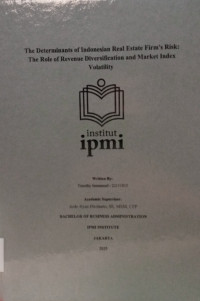
The Determinants of Indonesian Real Estate Firm's Risk: The Role of Revenue Diversification and Market Index Volatility
| Gmd : Text
| Availability :
- Share to:


This study investigates the determinants of firm risk among publicly listed property companies in Indonesia by analyzing how firm-specific and macroeconomic variables shape risk exposure under different market conditions. The research examines the impact of revenue diversification, exchange rate volatility (USD/IDR), land bank size, and urbanization rate on firm risk, with market volatility (proxied by IHSG standard deviation) included as a moderating variable. Using annual panel data from 2013 to 2023, the study employs quantitative methods through panel data regression to assess how internal strategies and external economic dynamics jointly influence risk levels in the property sector. Grounded in Expected Return Theory and the fundamental Risk–Return Trade-off, revenue diversification is expected to stabilize returns by reducing cash flow uncertainty across business segments, thereby lowering firm risk. Meanwhile, exchange rate volatility is anticipated to increase firm risk as fluctuations in foreign-denominated liabilities and imported construction costs create uncertainty in future earnings. Land bank ownership is predicted to have a dual effect: supporting
long-term earnings potential and reducing uncertainty when markets are stable, but potentially increasing financial exposure during periods of tight liquidity or declining demand. Additionally, the urbanization rate is expected to strengthen firm stability by supporting consistent demand for housing, commercial projects, and infrastructure in Indonesia’s rapidly urbanizing regions. Market volatility (IHSG) is expected to amplify these relationships by intensifying firms’ sensitivity to financial and operational uncertainty, particularly during periods of heightened market fluctuations.
This study contributes to the literature on real estate finance by integrating firm-level characteristics and macroeconomic variables into a comprehensive risk framework, highlighting how market volatility influences these relationships. The findings offer theoretical implications for risk management and diversification strategies in emerging markets and provide practical insights for investors, policymakers, and property developers seeking to strengthen resilience in Indonesia’s property sector.
Keywords: Risk, Diversification, Volatility, Landbank, Urbanization.
| Series Title |
-
|
|---|---|
| Call Number |
-
|
| Publisher Place | Jakarta |
| Collation |
75 hlm
|
| Language |
English
|
| ISBN/ISSN |
-
|
| Classification |
NONE
|
| Media Type |
-
|
|---|---|
| Carrier Type |
-
|
| Edition |
-
|
| Subject(s) |
-
|
| Specific Info |
-
|
| Statement |
-
|
| Content Type |
-
|
No other version available